
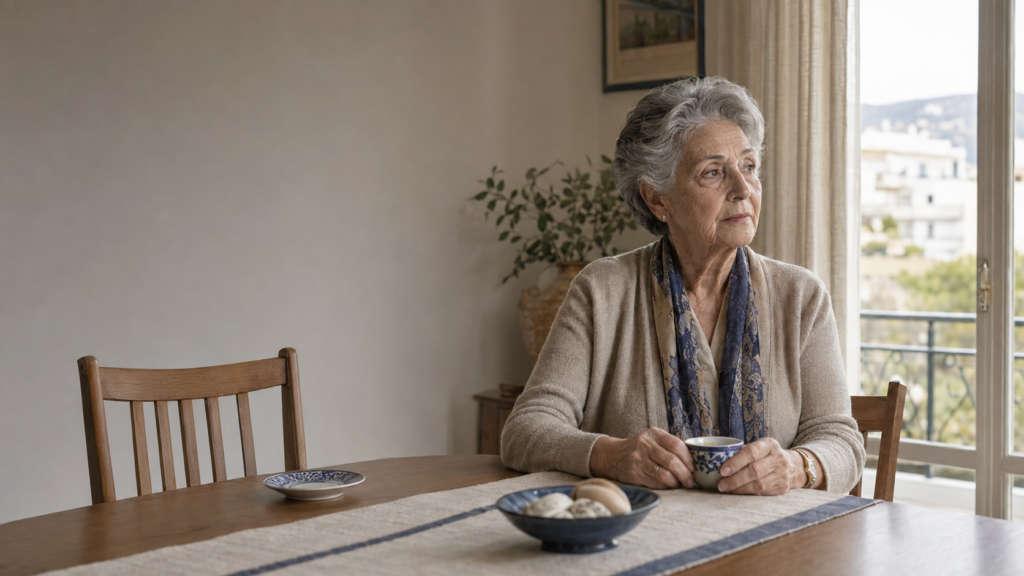
Loneliness in Later Life: The Silence That Should Never Become Routine
In a rapidly ageing country, human connection is not a luxury. It is essential to health, dignity and quality of life.
By the Zenely team | August 2026
A home can be clean, the fridge well stocked and every practical need taken care of—and yet something essential may still be missing: someone willing to sit down without rushing, ask, “How are you, really?” and stay long enough to hear the answer.
For many older people, the day is no longer filled with meetings, work, spontaneous outings and familiar voices. The hours stretch out quietly. A phone call may become the event of the day; a visit, the moment they have been waiting for since morning. Sometimes, however, neither the call nor the visit comes.
Loneliness in later life is often invisible. It does not always leave obvious signs, and it is rarely expressed plainly. It hides behind phrases such as “I’m fine”, “Don’t worry about me” or “You have enough to do already”. That is why it can remain behind a closed door for a long time, while its true weight goes unnoticed.
Loneliness does not simply mean living alone
Loneliness, social isolation and living alone are not the same thing.
A person may live alone, have friends, interests and meaningful relationships, and feel fulfilled. Conversely, someone may live with family or see people every day and still feel that no one truly understands or needs them.
The World Health Organization defines loneliness as the painful feeling that arises when there is a gap between the social connections a person wants and those they actually have. Social isolation is more objective: it means having few or insufficient social contacts and supportive relationships.[1]
In other words, the issue is not only how many people are around us. It is whether there is someone with whom we feel we belong—someone with whom we can share a thought, a fear or even a small moment of joy.
Greece is growing older—and the need is growing with it
The issue is particularly important in Greece. According to official data from the Hellenic Statistical Authority for 1 January 2025, the country’s resident population stood at 10,372,335. Of these, approximately 2.46 million people were aged 65 or over, representing 23.7% of the population. Around 739,000 people were aged 80 or over.[2]
Eurostat also reports that Greece’s median age reached 47.2 years in 2025, one of the highest in the European Union and a full eight years higher than in 2005.[3]
These figures are more than demographic indicators. They describe a society in which a growing number of people will live for many years after retirement—often after losing a spouse, with reduced mobility, or while their children work long hours or live far away.
Four figures worth remembering
- Almost one in four people in Greece is now aged 65 or over.[2]
- Around one in fourteen people is aged 80 or over.[2]
- Worldwide, approximately 8% of older people experience loneliness.[1]
- Around one in four older people is socially isolated, according to the World Health Organization.[1]
At the same time, the European Commission’s first EU-wide Loneliness Survey, involving more than 25,000 participants, found that in 2022, 13% of adults in the EU felt lonely “most or all of the time” during the previous four weeks, while 35% felt lonely at least some of the time. Greece was among the countries reporting the highest levels. These percentages refer to adults of all ages, not exclusively to older people; they nevertheless show that loneliness is already a wider social challenge in Greece.[4]
Why later life can bring greater vulnerability
Loneliness is not a normal or inevitable consequence of ageing. Over the years, however, events can accumulate and weaken even a strong social network:
- the loss of a spouse, siblings or close friends,
- retirement and the loss of daily contact with colleagues,
- difficulty walking, driving or using public transport,
- hearing or sight problems that make communication more tiring,
- chronic illness or being largely confined to the home,
- financial pressure that limits outings and activities,
- distance from children and grandchildren,
- digital exclusion, as services, communication and social life increasingly move onto a screen.
A cycle can then take hold: the person moves less, goes out less, loses confidence, withdraws and ultimately has even fewer opportunities for meaningful contact.
A Greek study published in 2024 used data collected during the pandemic in 2022 and examined older people receiving home-based support in Evrytania. This was a particularly vulnerable group and not a representative sample of the entire country. The study recorded high levels of loneliness in 54.1% of participants and high social isolation in 46.3%. The figures were even higher among people aged over 80, those living with frailty and those confined to their homes.[5] The findings cannot be generalised to all older people, but they clearly illustrate how vulnerable a person can become when reduced functional ability is combined with a lack of regular social contact.
When silence begins to affect health
Loneliness is not simply an unpleasant mood. The World Health Organization now recognises it as an important—and often neglected—social determinant of health. It has been associated with depression and anxiety, poorer quality of life, cognitive decline, cardiovascular problems and reduced longevity.[1]
A 2025 systematic review and meta-analysis combining 86 prospective and longitudinal studies of older adults found that social isolation was associated with a 35% higher risk of death from any cause. Living alone was associated with a 21% higher risk, and loneliness with a 14% higher risk.[6]
These findings show associations. They do not mean that loneliness alone causes every health problem, or that a person’s future is predetermined. They are, however, consistent enough to show why loneliness should never be dismissed as “just a little sadness that will pass”.
Families often care deeply—but cannot always be there
Behind an older person who feels alone, there is often a family who loves them and yet feels unable to do enough. Adult children may be trying to balance work, their own family, everyday responsibilities and support for a parent. When they live in another city or country, worry and guilt can become even more intense.
The answer is not to blame families. It is to recognise that a brief phone call, however valuable, cannot always replace regular physical presence, a walk, a shared meal or a conversation that does not happen with one eye on the clock.
Older people themselves often hide what they need. They do not want to “burden” their children, fear being seen as weak or believe they must accept loneliness as part of growing older. The silence may appear to protect the family, but it leaves the person even more alone.
Signs we should not overlook
There is no single sign that proves someone is experiencing loneliness. It is worth paying attention, however, when someone close to us:
- withdraws from activities they once enjoyed,
- calls frequently without a particular reason or, conversely, stops getting in touch,
- appears to lose interest in their appearance, home or meals,
- says there is “no point” in going out or that “nobody needs” them,
- shows persistent sadness, irritability, sleep disturbance or loss of interest,
- repeatedly finds reasons to avoid contact while also saying they feel alone.
These signs are not a diagnosis. When they are severe or persist—especially when there is hopelessness or any mention of self-harm—prompt contact with a doctor or mental health professional is essential.
What we can do today
Addressing loneliness does not always require grand gestures. What matters most is consistency, quality and genuine interest.
- Make contact predictable. A regular phone call or a visit on set days offers something deeply important: something to look forward to and a sense of security.
- Ask—and truly listen. Go beyond “Have you eaten?” or “Did you get everything you needed?” Ask “How was your day?”, “What do you miss?” or “What would you like us to do together?”
- Include the person in life, not only in care. A walk, a coffee, a shopping trip, choosing a meal or taking part in a family decision can reaffirm that they remain an active and valued member of the family.
- Make mobility possible. Many social connections are lost not because the desire has disappeared, but because getting there has become difficult.
- Seek support before exhaustion sets in. When a family cannot be present as often as needed, arranging reliable human companionship is not an abandonment of responsibility. It is a meaningful form of care.
A Greek study of a programme that regularly connected older people by telephone with trained volunteers found a significant reduction in loneliness after three months. Although the programme was not a randomised clinical trial, it offers a hopeful and practical message: consistent, organised human contact can make a genuine difference.[7]
Loneliness makes no noise. That does not mean it should remain unseen. Sometimes change begins with something simple: making the call today, staying a little longer and showing the person we love that they still have a place, a voice and a presence in our lives.
How Zenely can help
At Zenely, we do not see companionship as simply a way to “pass the time”. We see it as an essential part of everyday social care. Through carefully planned visits and thoughtful matching with a trained social care professional, we offer consistent human presence, conversation, walks, outings and shared activities, as well as support with shopping and everyday tasks, help using technology and safe accompaniment outside the home. Families receive responsible updates and the reassurance that their loved one is not spending each day unseen and disconnected. Zenely does not replace the family, medical care or psychological support. It works alongside them, creating a steady bridge to connection, activity and dignity.
Sources and research
- World Health Organization, Social isolation and loneliness (data and definitions, 2025–2026)
- Hellenic Statistical Authority, Estimated Population Data as at 1 January 2025 (published 18 December 2025)
- Eurostat, Demography of Europe – 2026 edition
- European Commission, Joint Research Centre, EU Loneliness Survey 2022 – Loneliness prevalence in the EU
- Klesiora M. et al., Frailty Assessment and Its Impact on Loneliness among Older Adults Receiving Home-Based Healthcare, Healthcare, 2024
- Nakou A. et al., Loneliness, social isolation, and living alone: a comprehensive systematic review, meta-analysis, and meta-regression of mortality risks in older adults, Aging Clinical and Experimental Research, 2025
- Balta M. et al., Combating Loneliness in Older Adults during the COVID-19 Pandemic: Findings from a Volunteer-Based Program in Greece, Behavioral Sciences, 2023